Essential Software Engineering Books for Building in the Age of AI Agents

The software engineering books that helped me level up — from fundamentals to system design. Still essential reading even as AI agents transform how we code.
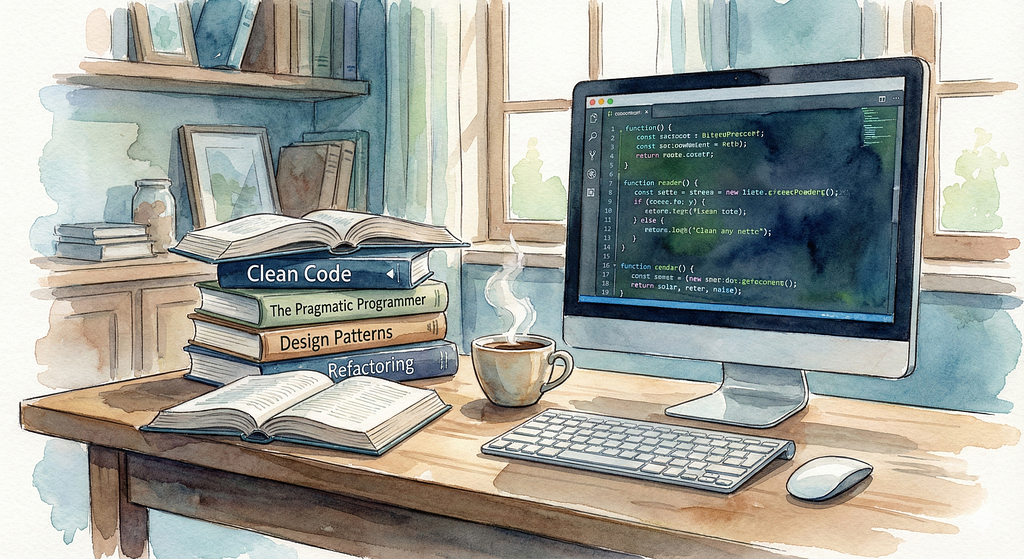
Over the decade of my career in the trenches of fintech and startups, I’ve realised that tutorials teach you how, but books taught me why.
Now, despite the rise of instant AI answers, reading remains essential for senior-level career growth for three reasons:
- Cognitive Reframing: Books develop the architectural thinking required for complex system design.
- Discovery of ‘Unknown Unknowns’: Unlike search-driven learning, books provide a holistic curriculum, where you learn vital concepts you wouldn’t even know to query or ask Chat.
- Technical Depth: They provide the foundational context that fintech and product-led teams require for scalable engineering.
Books give you mental models, patterns, and frameworks that no video can deliver in 10 minutes. They’re references I return to again and again, especially when I’m mentoring others or architecting systems that need to scale.
Let’s start from the core: Coding Fundamentals.
Best Books on Coding Fundamentals
As we’re entering an era where your IDEs can refactor files, write tests, scaffold features, and even reason about your codebase end-to-end.
Tools like Cursor, Copilot, and other agentic IDEs are no longer “assistants” — they’re collaborators. And paradoxically, that’s exactly why coding fundamentals matter more than ever.
Agentic tools are only as good as the constraints you give them. They amplify your taste, your judgment, and your mental models. If you don’t know what good looks like, these tools will happily help you ship well-structured nonsense at scale.
The books below don’t teach syntax. They teach standards. They help you recognise bad abstractions, spot leaky designs, and reason about tradeoffs — the kind of thinking no AI can outsource for you.
1. Clean Code — Robert C. Martin
Description:
Clean Code isn’t about rules — it’s about developing a sense of smell for bad code. In an AI-assisted workflow, this book becomes your quality filter. It teaches you how to judge whether the code your IDE generates is actually readable, maintainable, and honest.
Who it’s for:
Every developer using AI to write code (which is basically everyone now 😂).
Key takeaway:
AI can write code fast — you are still responsible for whether it deserves to exist.
👉 🛒 Get it on Amazon
2. The Pragmatic Programmer — David Thomas & Andrew Hunt
Description:
This book is less about code and more about thinking like a professional. Pragmatic Programmer teaches you how to ask better questions, set guardrails, and avoid blind automation.
Who it’s for:
Developers who want to stay relevant as tooling gets smarter.
Key takeaway:
Tools change. Judgment compounds.
👉 🛒 Get it on Amazon
3. Code Complete — Steve McConnell
Description:
If Clean Code sharpens your taste, Code Complete builds your discipline. It covers the mechanics of software construction — naming, structure, defensive coding — the exact areas where agentic tools need strong guidance to be effective.
Who it’s for:
Engineers working on large or long-lived codebases.
Key takeaway:
Great software isn’t generated — it’s constructed deliberately.
Best Books on System Design & Architecture
LLMs are now surprisingly good at system design diagrams. Ask one to design a URL shortener or a payments system and you’ll get a neat, confident answer in seconds. But what AI still can’t do reliably is understand context: your constraints, your products nuanced needs, your failure modes, your growth curve, and the messy realities of production systems.
System design is more about reasoning through tradeoffs under uncertainty. Cost vs reliability. Latency vs consistency. Simplicity vs extensibility (making judgment calls), than about just producing diagrams.
The books below train the exact skill: systems thinking. They give you a mental model that lets you evaluate AI-generated designs.
1. Designing Data-Intensive Applications — Martin Kleppmann
Description:
This is the closest thing our industry has to a physics textbook for distributed systems. DDIA gives you a deep, principled understanding of how databases, messaging systems, replication, and consistency models actually work — beyond vendor-specific implementations.
In an AI-driven workflow, this book becomes your lie detector. It helps you spot when a “clean” AI-generated design ignores reality — whether that’s network partitions, write amplification, or operational complexity.
Who it’s for:
Backend engineers, platform engineers, and architects building systems that need to scale and survive failure.
Key takeaway:
Every architecture is a set of tradeoffs — pretending otherwise is how systems fail in production.
2. System Design Interview — An Insider’s Guide
Description:
Despite the name, this book isn’t just about interviews. It teaches a structured way to think out loud about systems — clarifying requirements, identifying bottlenecks, and iterating toward a reasonable solution.
This is especially valuable in the age of AI, where it’s easy to jump straight to a “final architecture.” The real skill — in interviews and real projects — is showing how you reason your way there.
Who it’s for:
Senior engineers preparing for system design interviews or stepping into higher-impact architectural roles.
Key takeaway:
Clear frameworks beat clever answers — in interviews and in real systems.
Best Books on Data Engineering
When data pipelines break, metrics drift, or dashboards lie, AI doesn’t catch it. Humans do. And the engineers who understand how data is produced, transformed, and consumed are the ones who end up shaping these decisions and rising to these occasions.
The books in this section sharpen your data intuition. They teach you how to reason about data quality, analytical correctness, and system-wide impact — the skills that turn you from “the person who writes queries” into “the person leadership trusts.”
1. Data Engineering For Beginners — Chisom Nwokwu
Description:
This book does something rare: it explains data engineering without making it feel intimidating or abstract.
this book focuses on the fundamentals that still trip people up: data quality, security, governance, and system boundaries. It’s less about memorising tools and more about understanding why data systems are designed the way they are.
Who it’s for:
Aspiring data engineers, data analysts transitioning into engineering, and software engineers who work with data but want stronger foundations.
Key takeaway:
AI can help you write data code — but without fundamentals, you won’t know if the data is correct, secure, or trustworthy.
2. Fundamentals of Data Engineering — Joe Reis & Matt Housley
Description:
This is one of the clearest modern overviews of the data engineering landscape, from ingestion to transformation to serving. It demystifies the tooling and focuses on first principles instead of chasing trends.
AI can generate pipelines. This book teaches you how to design sustainable ones.
Who it’s for:
Backend and product engineers working close to data — not just “data engineers.”
Key takeaway:
Data architecture is a product decision, not just a technical one.
Now you have a roadmap to moving beyond surface-level tutorials and into true technical depth.
Building a great career in engineering is more about developing the “Book-ish” intuition (for lack of a better word) to see the patterns before they become problems. Whether you’re hacking a side project, building a startup or scaling a global product team, these titles are the gateway to the senior-level thinking that sets you apart.
Thanks for reading, buddy!
Leave a clap, share this article and do subscribe, if you found this article helpful. 👋

Tomisin Abiodun
Senior Software Engineer @ Checkout.com
I build scalable user-first experiences by combining technical expertise, product thinking and a deep understanding of AI, and I help others do the same.